
I'm a paragraph. I'm connected to your collection through a dataset. Click Preview to see my content. To update me, go to the Data Manager.
CONVERSATION · NYBALF 2026
The People We Make Family
Myriam J. A. Chancy and Angela Flournoy in conversation with Sony Ton-Aime
September 19, 2026 · Harlem Stage Gatehouse, New York
I'm a paragraph. I'm connected to your collection through a dataset. Click Preview to see my content. To update me, go to the Data Manager.
About the session
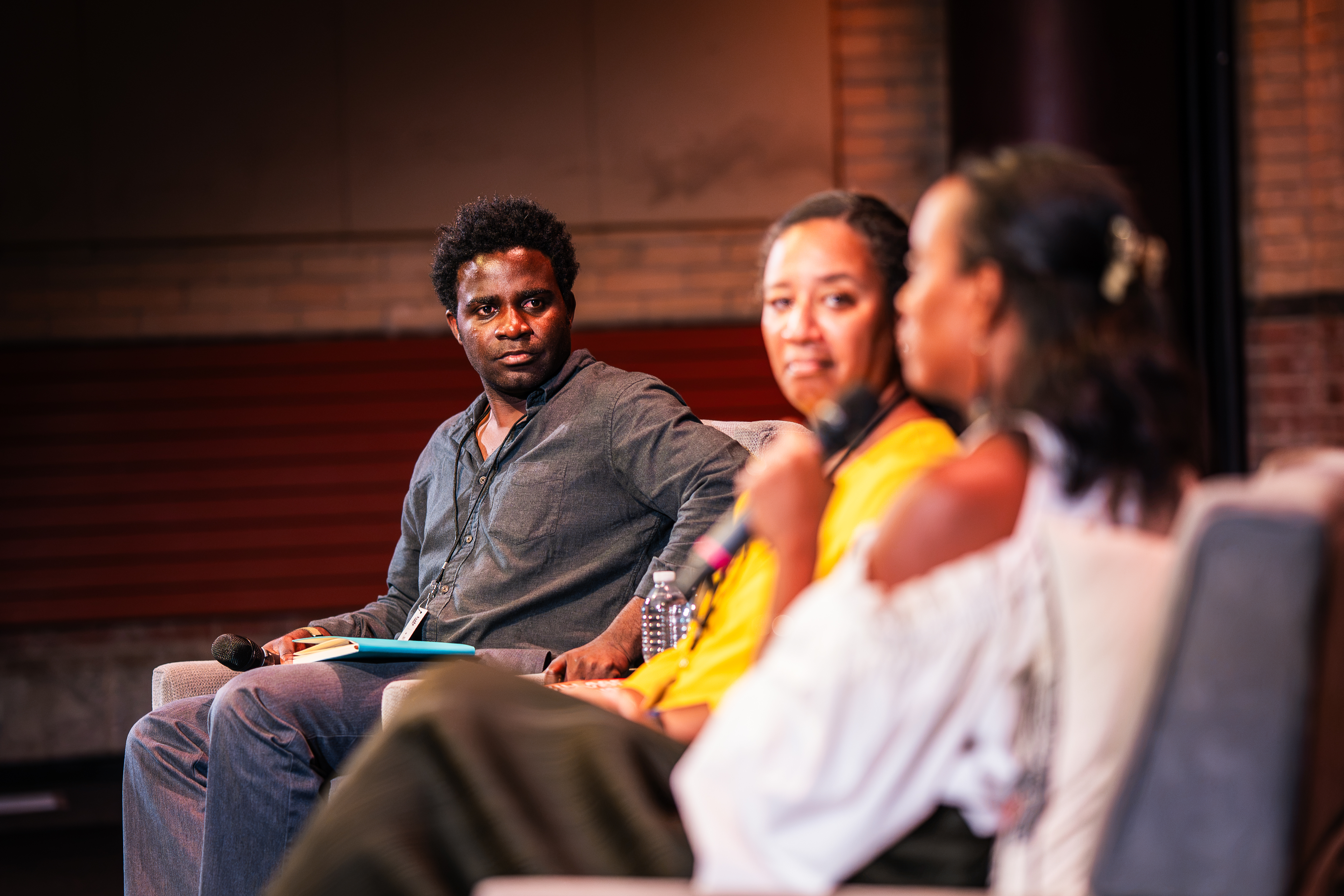
Sony Ton-Aime, who had brought both writers to Pittsburgh before he thought to put their books side by side, sets two novels of friendship in conversation: Myriam J. A. Chancy's Village Weavers, which follows two Haitian girls from 1940s Port-au-Prince through the Duvalier years and exile to old age, and Angela Flournoy's The Wilderness, which follows five Black women in New York and Los Angeles over twenty years. Chancy explains how her novel grew from her mother's lifelong friendship with a half-sister, and Flournoy describes writing hers across a decade that began in her late twenties.
The conversation turns on conflict as a condition of lasting friendship, on class and colourism within Black American and Haitian life, on migration and the word "dyaspora", and on the ways social media changes how friends quarrel and present themselves. Flournoy describes the friendship between her mother and the woman who helped raise her, and her doubts about the term "fictive kin"; Chancy draws on James Baldwin and on the Simbi, the Vodou spirits of connecting waters, to describe the love that holds her characters together. Audience questions turn to fractures within the diaspora, the claim to be "foundational", getting back to community, and friendship after the loss of a mother.
In their words
“Storytelling makes us humans, but friendship is what keeps us alive.”
SONY TON-AIME · 2:06 ↗
“In fact, the less a family has, my experience in Haiti has been, the more generous they are, the more they're willing to claim strangers as family.”
MYRIAM J. A. CHANCY · 19:36 ↗
“We don't give up on friendship when we realize that there is a love lost.”
MYRIAM J. A. CHANCY · 39:07 ↗
“I always think the act of writing the fiction itself is hopeful, especially in 2026.”
ANGELA FLOURNOY · 49:15 ↗
“I think people are going to have to figure out how to be more expansive when they think about who they are willing to be in community with.”
ANGELA FLOURNOY · 54:45 ↗
Key ideas
Friendship before questions of family
Chancy describes the friendship at the centre of Village Weavers as the kind children form on a playground, before they ask what family anyone comes from, and traces how the Duvalier regime, illegitimacy and exile interrupt it for decades without spoiling its origin.
The case for conflict
Flournoy argues that friends who bring their grievances to one another, and risk the uncomfortable conversation, are more likely to last than those who avoid conflict, and links the estrangements she heard about from older relatives to that avoidance.
Class within Black America and Haiti
Flournoy describes how differences of class surface between Black friends in their thirties and go unspoken because they are meant to be trivial. Chancy describes the colourism and class differentiation she saw fostered by Haiti's middle and elite classes, and the generosity of poorer families in claiming strangers as kin.
A generation that never called itself diaspora
Chancy contrasts her own encounter with the word “dyaspora” on a return to Haiti with her parents' generation, who left out of necessity, financed relatives who stayed, and never thought of themselves as anything but Haitians living abroad.
Fictive kin
Flournoy describes the fifty-one-year friendship between her mother and the woman who helped raise her, the practical agreements behind it, and why the word “fictive” sits uneasily with the bonds that formerly enslaved people and immigrant communities have needed to survive.
Solidarity beyond our own circle
Flournoy describes neighbours in Minneapolis delivering food and running errands for people afraid to leave their homes as a model of expansive community. Chancy describes characters who join others' resistance movements, from Algeria to the rights of Dominicans of Haitian descent, and connects that impulse to the history of the Haitian Revolution.
Chapters
00:00 Friends before we met
02:18 Why friendship sits at the center of both novels
06:15 What makes a friendship last decades
09:21 The case for conflict
12:49 Class, colorism and who gets to be family
20:51 Migration, new money and the diaspora
29:58 Distance, technology and memory
37:23 When to let a friendship go
41:44 When friends become family
47:17 What fiction can hold
53:29 Solidarity and what we owe one another
01:00:01 Q&A: the fractures within the diaspora
01:06:52 Q&A: who claims to be foundational
01:07:40 Q&A: getting back to community
01:08:50 Kinship across difference
01:10:36 Q&A: friendship after losing a mother
01:14:12 Thank you
Timestamps open the recording on YouTube at that point.
Participants

Featured author
Myriam J. A. Chancy is a Haitian Canadian American novelist and scholar, born in Port-au-Prince and raised there and in Quebec City and Winnipeg. Her novel Village Weavers (2024) won the 2025 OCM Bocas Prize for Caribbean Literature. She holds the Hartley Burr Alexander Chair in the Humanities at Scripps College and is a Guggenheim Fellow.

Featured author
Angela Flournoy is the author of the novels The Turner House (2015), a finalist for the National Book Award, and The Wilderness (2025), which follows five Black women across twenty years of friendship. A graduate of the Iowa Writers' Workshop, she was raised in Southern California and lives in New York.

Moderator
Sony Ton-Aime is a Haitian poet, essayist and translator from Ouanaminthe, and the Executive Director of Pittsburgh Arts & Lectures. He previously directed literary arts at the Chautauqua Institution. His poetry collection Konbit was published by Carnegie Mellon University Press in 2026.
Photographs


Reading list
Central works
Myriam J. A. Chancy
Village Weavers
Tin House · 2024
Chancy's novel of two girls in 1940s Port-au-Prince, Sisi and Gertie, separated by class, colour, a family secret and the Duvalier years, who reconnect six decades later in the United States.
MENTIONED BY SONY TON-AIME AT 02:18 ↗
Angela Flournoy
The Wilderness
Mariner Books (HarperCollins) · 2025
Flournoy's novel following five Black women in New York and Los Angeles across twenty years of friendship, conflict and changing fortunes.
MENTIONED BY SONY TON-AIME AT 02:18 ↗
Works referenced in the session
Angela Flournoy
The Turner House
Houghton Mifflin Harcourt · 2015
Flournoy's first novel, about a Detroit family of thirteen siblings and the house that holds their history; a finalist for the National Book Award. Ton-Aime names it in his introduction.
MENTIONED BY SONY TON-AIME AT 00:29 ↗
Margo Jefferson
Negroland: A Memoir
Pantheon · 2015
Jefferson's memoir of growing up in Chicago's Black upper class, cited by Flournoy as one of the few works on class within Black America.
MENTIONED BY ANGELA FLOURNOY AT 25:39 ↗
Marlon James
The Disappearers
Riverhead Books · 2026
James's novel of gay life and homophobic violence in Jamaica in the 1980s and 1990s, shortlisted for the 2026 Booker Prize. Flournoy recommends it and cites Dwight Garner's review.
MENTIONED BY ANGELA FLOURNOY AT 47:52 ↗
Aube Rey Lescure
River East, River West
2023
A novel by Aube Rey Lescure, who visited Chancy's memoir class; Chancy names it at 00:50:30.
MENTIONED BY MYRIAM J. A. CHANCY AT 50:50 ↗
Further reading
Recommended by NYBALF. Not discussed in the session.
Myriam J. A. Chancy
What Storm, What Thunder
Tin House · 2021
Chancy's choral novel of the 2010 earthquake in Haiti, winner of an American Book Award.
Myriam J. A. Chancy
The Loneliness of Angels
2010
Chancy's novel, winner of the 2011 Guyana Prize for Literature Caribbean Award.
Myriam J. A. Chancy
Framing Silence: Revolutionary Novels by Haitian Women
1997
The first book-length study of Haitian women's literature.
Myriam J. A. Chancy
Harvesting Haiti
2023
One of Chancy's scholarly books.
Sony Ton-Aime
Konbit
Carnegie Mellon University Press · 2026
Ton-Aime's poetry collection.
Sony Ton-Aime
LaWomann
2019
Ton-Aime's chapbook.
Read the transcript
Read the complete session in its edited transcript.
READ TRANSCRIPT (PDF, 23 pages) ↗
Continue exploring

CONVERSATION · NYBALF 2025
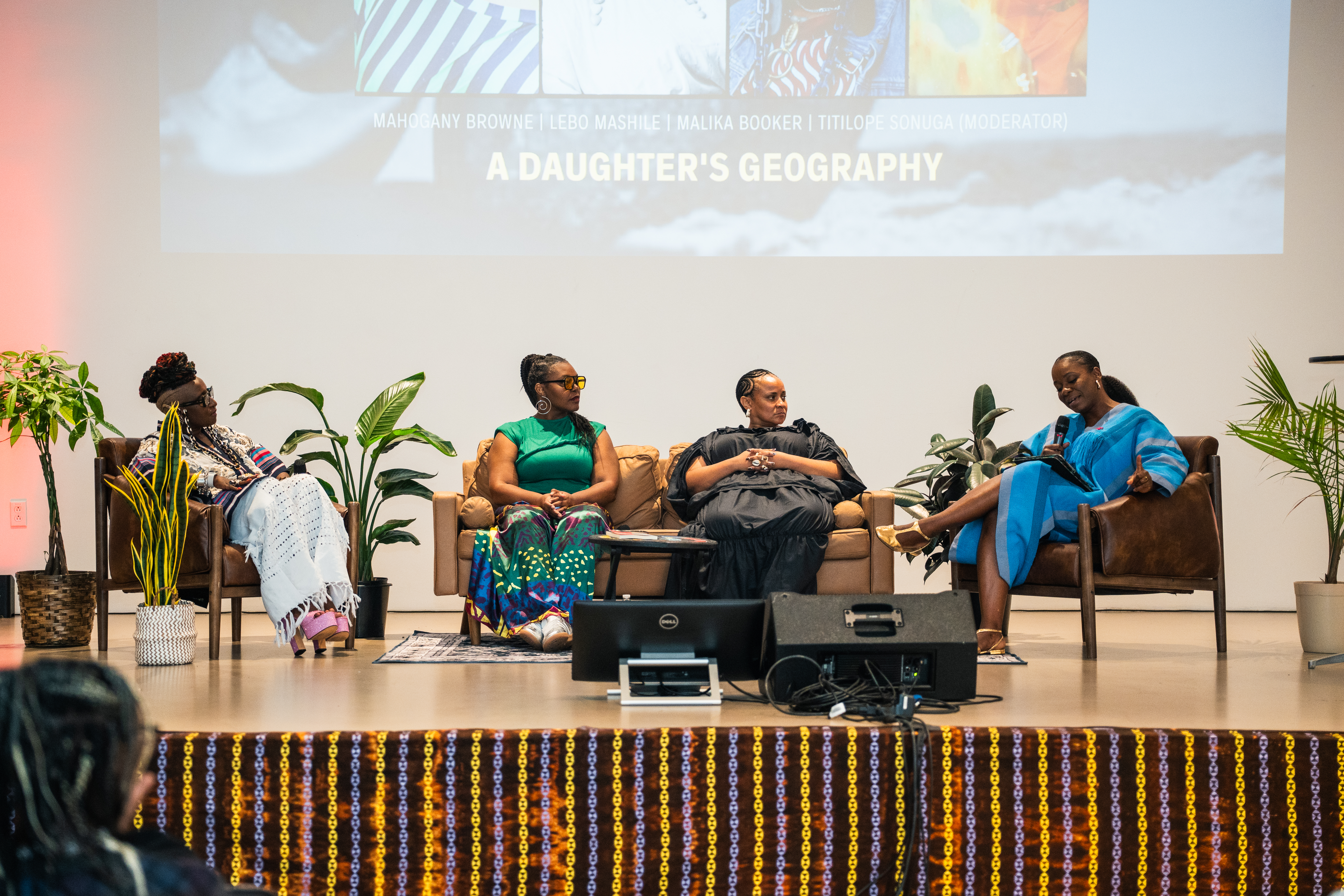
Lebo Mashile, Mahogany L. Browne and Malika Booker in conversation with Titilope Sonuga
Presented by Harlem Stage. Supported by the Open Society Foundations.