
I'm a paragraph. I'm connected to your collection through a dataset. Click Preview to see my content. To update me, go to the Data Manager.
CONVERSATION · NYBALF 2026
The Burning Ground
Oil and militancy in the Niger Delta
Noo Saro-Wiwa in conversation with Alexis Okeowo
September 19, 2026 · Harlem Stage Gatehouse, New York
I'm a paragraph. I'm connected to your collection through a dataset. Click Preview to see my content. To update me, go to the Data Manager.
About the session
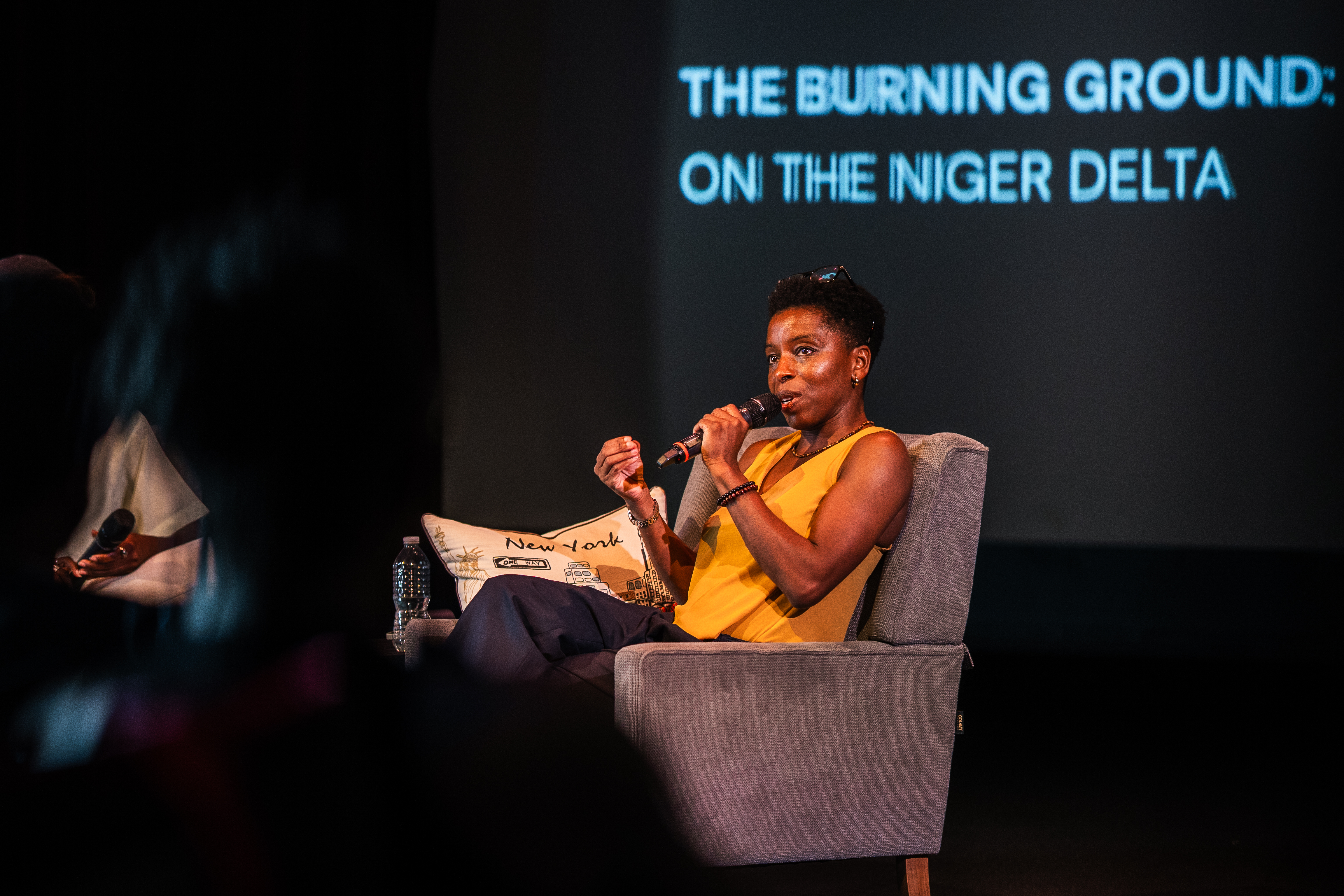
Thirty years after her father, Ken Saro-Wiwa, and eight of his colleagues were executed by Nigeria's military government, Noo Saro-Wiwa returned to the Niger Delta to write The Burning Ground. In conversation with Alexis Okeowo, she places the Delta in the world economy, from the slave trade and the palm oil that fed Britain's industrial revolution to the crude that supplied cheap energy to the West, and describes a wetland of creeks, mangroves and emerald water that decades of spills have made hard to recognise.
Saro-Wiwa follows the arrival of the oil companies under military rule, the divisions created when one community received benefits and the next did not, and how her father's peaceful campaign, answered with execution, taught a generation that only violence would be heard. She discusses the amnesty that turned former militants into chiefs and security contractors, illegal refining, the unrecognised work of women as peacekeepers and farmers, the "ecological amnesia" of children who have never seen fireflies, Shell's exit and the UNEP-led cleanup, and her own work connecting solar projects with Delta communities. Audience questions turn to solar power in practice, memories of her father, the land before oil, the oil economy and conservation.
In their words
“The Niger Delta is a real cautionary tale about how oil and corruption can really change a society in ways that you can't predict.”
NOO SARO-WIWA · 1:41 ↗
“As one former militant told me, he said, “If you don't make noise, they won't hear you.””
NOO SARO-WIWA · 10:32 ↗
“Yeah, I think women are the really unsung heroes of the Niger Delta.”
NOO SARO-WIWA · 15:39 ↗
“Feminism isn't some sort of anti-man thing. It's like if you help the women, you help society as a whole.”
NOO SARO-WIWA · 18:44 ↗
“We just need to be free from the shackles of oil”
NOO SARO-WIWA · 34:50 ↗
Key ideas
A region the world has neglected
Saro-Wiwa describes the Delta as one of the most unsung regions of the world: a source of enslaved people, of the palm oil that powered industrialisation and of cheap crude for the West, and the third largest wetland on earth, largely neglected and unseen.
How violence became the language
After her father's execution, Saro-Wiwa argues, peaceful protest came to seem pointless. Militant groups formed from former cults and gangs, the amnesty made their leaders chiefs and contractors, and their wealth turned into political power.
The women of the Delta
Saro-Wiwa describes women mediating between warring communities without state money, losing out when compensation goes to male landowners, and raising children alone in a system of polygamy that leaves sons to support their siblings.
Ecological amnesia
Comparing the Delta to the English countryside, Saro-Wiwa describes how each generation's sense of what the land should look like shifts, so that children growing up now do not miss the monkeys, pythons and fireflies her father once pointed out.
Solar power as liberation
Saro-Wiwa sees the rollout of solar energy as a way to free people from dependence on oil companies and former militants and to release Nigeria's entrepreneurial energy, and later describes the community in Delta State that now runs on solar power.
Chapters
00:00 Why the Niger Delta, thirty years on
02:40 Slave trade, palm oil and crude
06:11 Oil companies, the military and the land
09:29 How violence became the language of the Delta
14:51 The women of the Niger Delta
20:14 Illegal refining
25:03 Ken Saro-Wiwa's legacy and ecological amnesia
28:47 Conservation in a region run by former militants
32:21 Sources of hope and the case for solar
35:02 Shell's exit, UNEP and the cleanup
38:33 Writing the book and finding a way to help
42:53 Q&A: solar power in Delta communities
45:41 Q&A: remembering Ken Saro-Wiwa
50:35 Q&A: the land before oil
53:38 Q&A: will solar threaten the oil economy?
57:54 Q&A: wildlife and national parks
01:03:29 Closing
Timestamps open the recording on YouTube at that point.
Participants

Featured author
Noo Saro-Wiwa is a writer and journalist born in Port Harcourt and raised in England. She is the author of Looking for Transwonderland: Travels in Nigeria, named the Sunday Times Travel Book of the Year, Black Ghosts, which won the 2025 Edward Stanford Travel Book of the Year award, and The Burning Ground: Oil and Militancy in Nigeria (2026). She lives in London.

Moderator
Alexis Okeowo is a staff writer at The New Yorker, where she has reported on conflict, human rights and culture across Africa, Mexico, Europe and the American South since 2010. She is the author of A Moonless, Starless Sky, winner of the 2018 PEN Open Book Award, and Blessings and Disasters: A Story of Alabama (2025).
Photographs


Reading list
Central works
Noo Saro-Wiwa
The Burning Ground: Oil and Militancy in Nigeria
Columbia Global Reports · 2026
Saro-Wiwa's account of the Niger Delta thirty years after her father's execution: oil, militancy, illegal refining, the women of the region and the case for solar power.
MENTIONED BY ALEXIS OKEOWO AT 00:08 ↗ · PUBLISHER ↗
Further reading
Recommended by NYBALF. Not discussed in the session.
Noo Saro-Wiwa
Looking for Transwonderland: Travels in Nigeria
Granta Books · 2012
Saro-Wiwa's account of travelling across Nigeria, the country of her birth; the Sunday Times Travel Book of the Year.
Noo Saro-Wiwa
Black Ghosts: A Journey Into the Lives of Africans in China
Canongate · 2023
Saro-Wiwa's journey through the lives of African migrants in China; winner of the 2025 Edward Stanford Travel Book of the Year award.
Alexis Okeowo
Blessings and Disasters: A Story of Alabama
Henry Holt and Co. · 2025
Okeowo's account of Alabama, the state where she grew up, blending memoir, history and reporting.
Alexis Okeowo
A Moonless, Starless Sky: Ordinary Women and Men Fighting Extremism in Africa
2017
Okeowo's first book, winner of the 2018 PEN Open Book Award.
Read the transcript
Read the complete session in its edited transcript.
READ TRANSCRIPT (PDF, 20 pages) ↗
Continue exploring
KEYNOTE · NYBALF 2025
Howard W. French in conversation with Kọ́lá Túbọ̀sún
Presented by Harlem Stage. Supported by the Open Society Foundations.