
I'm a paragraph. I'm connected to your collection through a dataset. Click Preview to see my content. To update me, go to the Data Manager.
KEYNOTE · NYBALF 2025
The Second Emancipation
Howard W. French in conversation with Kọ́lá Túbọ̀sún
September 7, 2025 · The Africa Center, New York
I'm a paragraph. I'm connected to your collection through a dataset. Click Preview to see my content. To update me, go to the Data Manager.
About the session
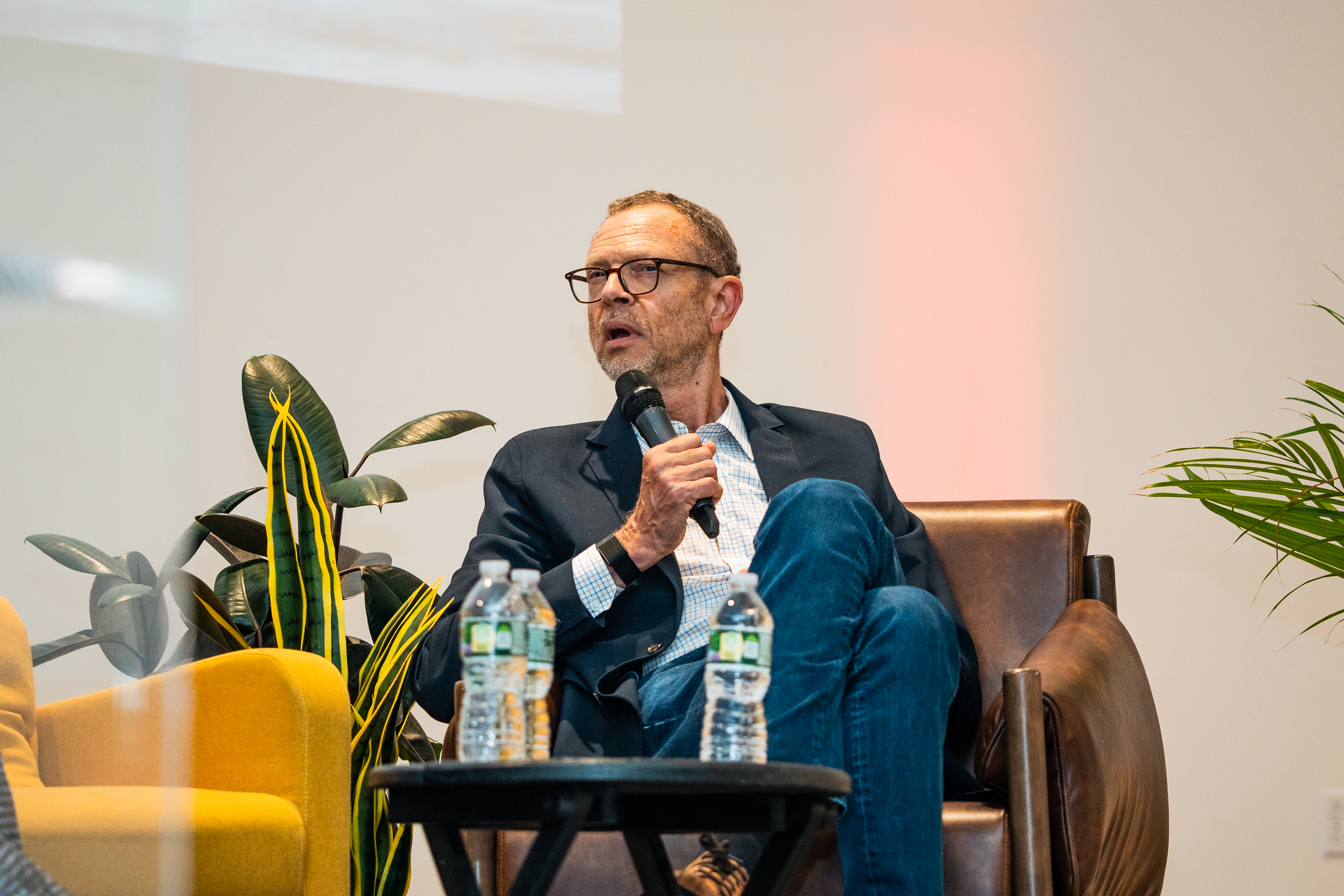
In conversation with Kọ́lá Túbọ̀sún at The Africa Center in Harlem, Howard W. French discusses The Second Emancipation, his history of Kwame Nkrumah, Ghana's first president, and of the Pan-African movement Nkrumah came to embody. French explains how he came to the subject, from his first journeys into Ghana from Ivory Coast in the 1970s to his parents' membership of a Friends of Ghana society in Washington, and traces the chain of chances that took Nkrumah from a village school to Achimota College, into the orbit of Nnamdi Azikiwe, and on to Lincoln University and Harlem.
French describes Pan-Africanism as a relay race passed back and forth between Africa and the Americas, and the present quarrels between Africans and African Americans as the fruit of a long campaign to divide. The conversation covers Nkrumah's private life and his marriage to an Egyptian wife as a symbolic union of the continent, his turn to personal rule in a state left without a civil service, the Kennedy administration and the Akosombo Dam, and Nigeria's "big-country complex". Audience questions address a journalist writing history, China in Africa, neocolonialism, Thomas Sankara, Nkrumah's support for liberation movements across the continent, and Benin's law offering citizenship to members of the African diaspora.
In their words
“The other thing is that Africans and the African diaspora are each other's greatest resource.”
HOWARD W. FRENCH · 39:41 ↗
“Nkrumah was not willing to be anybody's boy.”
HOWARD W. FRENCH · 33:37 ↗
“He believed it. He lived it and he put his money behind it or his country's money behind it”
HOWARD W. FRENCH · 1:09:16 ↗
Key ideas
A chain of coincidences
French traces the improbable sequence that made Nkrumah: a mother who persuaded his father to educate him, a priest who noticed him, a place in the first class at Achimota, and the influence of Azikiwe and an assistant headmaster who had both studied in the United States.
Pan-Africanism as a relay race
French describes the history of Pan-African thought as a relay in which the lead passes between Africa and the Americas from one period to the next, and attributes today's divisions between Africans and African Americans to a long campaign to divide and conquer.
A state with no one to delegate to
French explains Nkrumah's turn to personal rule partly by the colony the British left behind, an extractive economy with no trained senior civil service, which persuaded a capable leader that he had to do everything himself.
Modernity on its own terms
Recounting how the Kennedy administration strung Nkrumah along over loan guarantees for the Akosombo Dam as cocoa prices collapsed, French frames Nkrumah's struggle, and Africa's since, as a struggle to enter modernity on its own terms.
Each other's greatest resource
French names two things Nkrumah was right about: that Africa must unite, and that Africans and the African diaspora are each other's greatest resource, so that failing to mobilise that resource in a common project harms both.
Return made practical
Asked whether a migration of African Americans to the continent could be sustained, French says it takes work on both sides, contrasts Ghana's hesitancy with a Beninese law offering citizenship to members of the diaspora, and recommends Benin to those considering a move.
Chapters
00:00 Introduction
02:21 Why Nkrumah
08:05 Africans and African Americans: a relay race
20:00 Nkrumah's private life
25:40 Idealism, authoritarianism and the Akosombo Dam
34:15 America, the Cold War and African interests
40:10 Azikiwe, Nigeria and the big-country complex
46:27 Audience questions: a journalist writing history
52:57 Audience questions: China and Africa
58:06 Audience questions: neocolonialism
01:04:15 Sankara and the open road
01:07:58 Audience questions: Pan-Africanism across regions
01:13:01 Audience questions: returning to Africa
Timestamps open the recording on YouTube at that point.
Participants

Howard W. French
Featured author
Howard W. French is a journalist and historian and a professor at the Columbia University Graduate School of Journalism. A former New York Times bureau chief in Central America and the Caribbean, West and Central Africa, Japan and China, he is the author of six books, including Born in Blackness (2021) and The Second Emancipation: Nkrumah, Pan-Africanism, and Global Blackness at High Tide (2025).

Moderator
Kọ́lá Túbọ̀sún is a Nigerian poet, linguist, translator, filmmaker and publisher. His poetry collections are Edwardsville by Heart (2018), Ìgbà Èwe (2021) and Èṣù at the Library & Other Poems (2024). He founded the YorubaName.com dictionary project and publishes OlongoAfrica. He serves on the NYBALF board.
Photographs


Reading list
Central works
Howard W. French
The Second Emancipation: Nkrumah, Pan-Africanism, and Global Blackness at High Tide
Liveright (W. W. Norton) · 2025
French's history of Kwame Nkrumah and the Pan-African movement, and of how African independence and the American civil rights struggle shaped each other. The subject of the conversation.
MENTIONED BY KỌ́LÁ TÚBỌ̀SÚN AT 00:23 ↗
Works referenced in the session
Howard W. French
Born in Blackness: Africa, Africans, and the Making of the Modern World, 1471 to the Second World War
Liveright (W. W. Norton) · 2021
French's history of Africa's central place in the making of the modern world from 1471 to the Second World War; the book preceding The Second Emancipation.
MENTIONED BY HOWARD W. FRENCH AT 05:21 ↗
Kwame Nkrumah
Africa Must Unite
Heinemann · 1963
Nkrumah's case for the political unification of the African continent. French names it at 00:39:35.
MENTIONED BY HOWARD W. FRENCH AT 39:40 ↗
Howard W. French
China's Second Continent: How a Million Migrants Are Building a New Empire in Africa
Alfred A. Knopf · 2014
French's reported account of Chinese migrants in Africa, based on travel across the continent. Discussed in the audience questions at 00:53:33.
MENTIONED BY HOWARD W. FRENCH AT 53:48 ↗
Mahmood Mamdani
Slow Poison: Idi Amin, Yoweri Museveni, and the Making of the Ugandan State
Harvard University Press · 2025
Mamdani's account of Uganda under Idi Amin and Yoweri Museveni, written partly from his own experience of expulsion and return. The book is the subject of the conversation.
MENTIONED BY HOWARD W. FRENCH AT 01:02:34 ↗ · PUBLISHER ↗
Further reading
Recommended by NYBALF. Not discussed in the session.
Howard W. French
Everything Under the Heavens
2017
French's book on China and its ambitions in Asia.
Howard W. French
A Continent for the Taking
2004
French's account of Africa, drawn from his years as a correspondent there for The New York Times.
Kọ́lá Túbọ̀sún
Edwardsville by Heart
2018
Túbọ̀sún's first poetry collection.
Emily R. Grosholz
Ìgbà Èwe: Translated Poems of Emily R. Grosholz
Translated by Kọ́lá Túbọ̀sún · 2021
Túbọ̀sún's Yorùbá translations of poems by Emily R. Grosholz.
Kọ́lá Túbọ̀sún
Èṣù at the Library & Other Poems
2024
Túbọ̀sún's most recent poetry collection.
Read the transcript
Read the complete session in its edited transcript.
READ TRANSCRIPT (PDF, 25 pages) ↗
Continue exploring

CONVERSATION · NYBALF 2026